Article by Eileen Haskett
Community Involvement
Proyecto Playa Istmito was a citizen science initiative led by the STRI Bocas Research Station, with data collection beginning July 2023 and ending June 2024. The project’s primary focus was to educate students of the Bocas del Toro archipelago on an algal bloom frequently occurring on Playa Istmito in Las Cabañas, Isla Colón, while collecting preliminary data on bloom presence/absence and additional physical parameters.
Our objective was the answer the following questions:
What is the species of the primary dark matter that washes ashore?
How often does the bloom occur? Is it seasonal or year-round?
Where is the deposit usually located on the beach?
This initiative successfully educated over 500 students on the scientific process, including formulating hypotheses and data collection, as well as on the nature of algae and the occurrence of algal blooms. This project acts as a pilot effort in identifying the cause of this ecological concern and will contribute to the existing knowledge of similar occurrences.
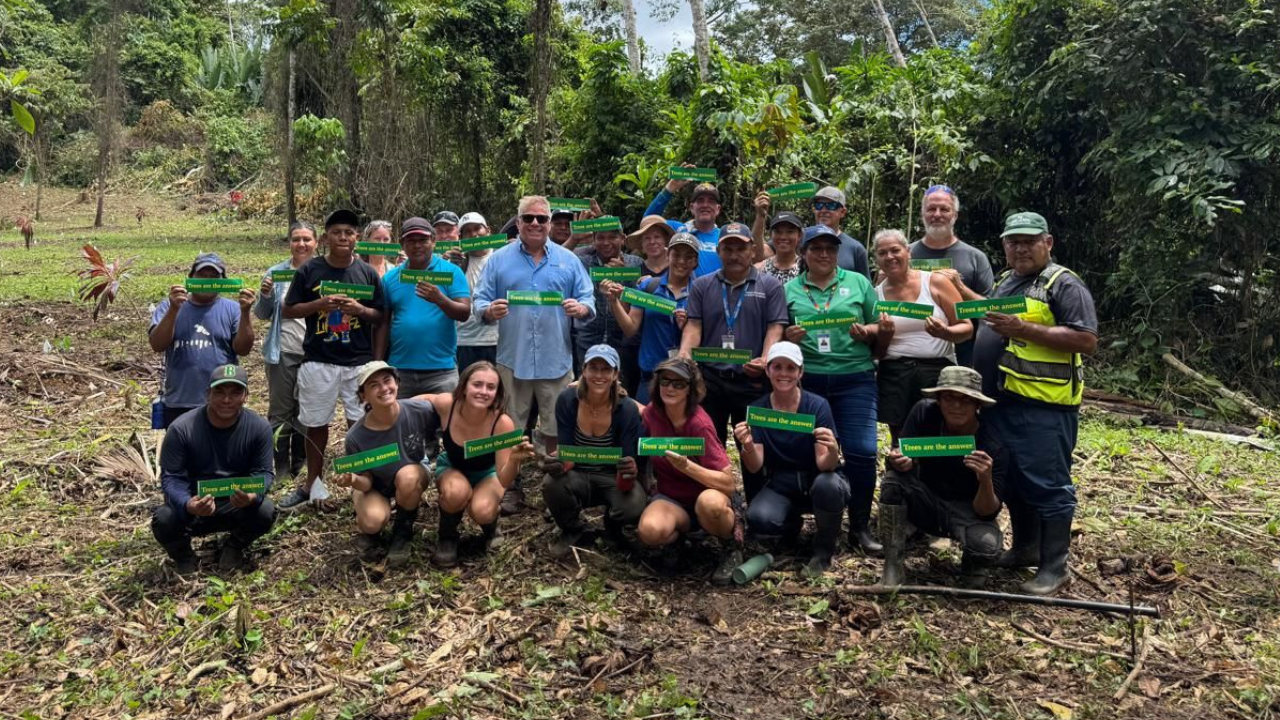
In all, 10 schools and centers participated in the project. Given the range in ages of students, activities and lessons were tailored to each grade level (Fig. 1).
We would like to take this opportunity to sincerely thank all students and teachers who volunteered their time to help with this initiative. In addition to being extremely entertaining, the students of Bocas del Toro are smart, kind, and curious individuals, and this project would not have been successful without their key contributions.

Preliminary Analysis
Playa Istmito is host to an ever-changing assemblage of deposits washing ashore, typically consisting of macroalga species, various species of seagrass, and an unidentified dark-brown matted growth. The persistent growth, of which we will be discussing throughout this report, may be Lyngbya majuscula, a kind of cyanobacteria colloquially known as mermaid’s hair or fire weed. This initial identification was performed by Alberto Saa et al. in 2016 1 during a pioneering study with the objective of identifying the algae species and determining a possible origin of the deposits. However, the species remains to be formally confirmed through DNA sequencing with 16S.
Cyanobacteria Sample Analysis
The bloom appears to only affect Playa Istmito, although deposits will rarely appear at Sand-Dollar Beach. The algae typically wash ashore in one of either two forms: as a dark brown, filamentous mat or in small, 1.5-centimeter balls of the same color (Fig. 2), which appear to be the same organism upon microscopic inspection (Fig. 3).


These forms both appear to be the same species under a microscope. An interesting aspect of the ball-form algae is that they contain a greater quantity of silicate spicules.
Shallow free dives throughout the bay during June 2024 showed that the matted material in question was found exclusively in front of Playa Istmito, approximately 180 meters from the shoreline, 10 – 15 feet in depth from the surface (Fig. 4).

Samples of the matted growth were left in sealed bags in a lab refrigerator from the months of February to May 2024. Upon inspection with a compound microscope in May, both matted and ball-form samples were bright green in phenotype in comparison to fresh samples (Fig. 5). This aligns with a phenomenon that occurs with mermaid’s hair/fireweed in nitrate-free media, initially described by Jones et al. 2 Nitrate is ubiquitous in marine environments and can originate from natural or anthropogenic sources. It is an important source of nitrogen, which is essential to plant growth, although when available in excess through nutrient pollution can result in algal and cyanobacterial blooms. While it cannot be confirmed that the fridge samples were kept in an environment completely free of nitrate, it proves to be an interesting coincidence with the phenomenon described in the aforementioned study.


Beach Deposit Analysis
Observations of algae deposits on Playa Istmito were recorded biweekly from July 2023 to June 2024. Between the dates of July 7th, 2023 and June 12th, 2024, 189 presence/absence points were recorded. Of times visited, 181of the 189 days had some form of deposit of varying age, and 65 of the days had a new deposit of cyanobacteria.
The percentage of days visited in which a new deposit was present by month depicts the number of days in which a geographically/materially distinct deposit from previous days was found on the beach. Using a single-factor ANOVA with a significance value of 0.05, the p-value was 0.56, indicating that there was no detectable significant difference between presence of a new deposit per month (Fig. 8).

Figure 9 depicts location of new deposits by week and month. The deposit notably tends to be deposited towards the north of the beach, with increased variability of deposit location in months with greater storm action and swell.

DNA Sequencing and Additional Microscope Analysis
Algae material samples from Playa Istmito were sent to Princeton University for genetic identification of 16S species, i.e. the presence of prokaryotes/bacteria and 18S species, i.e. eukaryotes (algae/diatoms). This analysis provided genetic evidence that the so called ‘beach algae’ sample was a mixture of many bacterial species, including cyanobacteria. The cyanobacteria signal may be Lyngbea, but cannot conclusively be identified without further sequencing targeting specific genes.
For the 18S sequencing, a coral reef/benthic diatom was identified, likely in the Rhabdonematales family. Diatoms within this family are epiphytic, meaning they grow on surfaces of other vegetative organisms such as macroalgae. Diatoms produce silicate material, which may be responsible for the spicule-like artifacts within the sample.
Analysis of the sample through further microscopy using a ZEISS Stemi 508 microscope revealed the morphology is non-branching and filamentous, with coin-like internal organization matching the morphology of L. majuscula, supporting the hypothesis that the primary organism is the cyanobacterium (Fig. 10).


Figure 10. Microscope images of material from Playa Istmito taken by Dr. Noelle Lucey using a ZEISS Stemi 508 microscope. a) 10x magnification. b) 40x magnification. c) 100x magnification in which coin-like internal structure is present.
Discussion
Preliminary analysis of new deposits show that there is no difference in time of year for cyanobacteria deposits. New deposits appeared on the beach regardless of time of year, and cyanobacteria was consistently present on the beach in some capacity from July 2023 to June 2024. This suggests that factors influencing its growth are perhaps not dependent on seasonal environmental changes and may be present throughout the year.
Mapping of new deposits based on GPS coordinates depict that the deposit tends to remain on the upper end of Playa Istmito, with greater variability in deposit location in months with increased storm action (January, February, March, July).
Despite our initial objectives, we were unable to accurately measure biomass of deposits, given the variability of deposit composition; the deposits typically aggregate other algae species and sand within its masses, adding complexity to quantifying the cyanobacteria deposit biomass with basic spatial measurements. This leads to uncertainty as to whether deposit biomass varies seasonally; the cyanobacteria is always present, but deposit intensity may increase or decrease under certain cyclical climatic conditions.
While the species cannot be officially determined, we suspect that the black matted material in question is Lyngbya majuscula, as it shares many similarities with L. majuscula in terms of its morphology, growth patterns, and dermatitis-inducing effects.
Tidal Current Theory
Following our preliminary findings, we consulted two sailors within the Bocas community with experience in analyzing current direction, in addition to experience living in situ where currents pass through the bay. Both hypothesized that the area directly in front of the beach is somewhat of a circulation dead zone and does not receive adequate circulation in comparison to other areas throughout the bay. We suspect that the area directly in front of Playa Istmito acts as a sink for nutrients that are pulled from surrounding Bocas Town areas and Almirante Bay into this area with the outgoing tide.

Lyngbya majuscula and Cyanobacterial Blooms
We suspect that the black matted material in question is Lyngbya majuscula, or a closely related species.
Lyngbya majuscula is the most common species of bloom-forming cyanobacteria reported for marine waters, with reported blooms intensifying in abundance and duration in the last several decades. 3 The species grows from the intertidal zone to 30 meters below the surface on benthic substrate such as ocean floor sediment, macroalgae, seagrasses and corals. It is diazotrophic, meaning it fixes dinitrogen (N2), and is versatile in its nitrogen sourcing: it can fix both inorganic as well as organic (urea) nitrogen forms.3 Despite reports documenting nitrogen fixation in L. majuscula, it has been shown to persist in environments free of nitrogen sources, and genes associated with nitrogen fixation were not found during genome analysis. 2 It is especially sensitive to iron (Fe) availability, a required component in its mechanism of nitrogen fixation; L. majuscula blooms have been historically linked with land development runoff containing organic iron. 5
L. majuscula releases a variety of toxins: two compounds, Lyngbyatoxin-A and debromoaplysiatoxin, have been documented to induce asthma-like symptoms and severe dermatitis in humans6, and have been speculated to induce tumor growth in green sea turtles feeding on L. majuscula-covered seagrass. 7 Blooms are a growing cause for concern, as the toxic blooms affect surrounding wildlife, with instances of of L. majuscula smothering benthic seagrass and coral communities documented in the Canary Islands.8
Instances of cyanobacterial blooms have been on the rise globally since the mid-twentieth century and are projected to increase in frequency under current climate change model predictions. Environmental drivers for their increased prevalence include eutrophication, rising CO2 concentrations/decreased pH, and temperature. The input of nutrients, namely nitrogen and phosphorus from human activities such as intensified agriculture and wastewater overflow, has contributed dramatically to the rise in cyanobacterial blooms. In addition, many cyanobacteria species reach their maximum growth rate at temperatures of 25 °C or higher, thus increasing their frequency with rising global temperatures, especially so in warmer climates. 9
We hope that future DNA sequencing studies will help determine if the mats on Playa Istmito are indeed L. majuscula or a related species.
Sequential Projects
A supporting project to this effort, funded by the Life on a Sustainable Planet Initiative at the Smithsonian Institution that will include oceanographers and biogeochemists, is currently underway. This work will define currents within the bay and to determine if anthropogenic eutrophication is fertilizing the cyanobacteria growth through isotope analysis.
Additionally, research efforts by Princeton collaborators will be sampling water at Ismito and throughout the bay to identify levels of human-specific fecal contamination this April.
Funding Source
Funding for this project was graciously provided by the Smithsonian Women’s Committee.
Acknowledgements
We would like to thank the participating students and teachers of Bocas del Toro, Alberto Saa, Rachel Collin, Viviana Guerra, Noelle Lucey, Bess, Ward, Urania Gonzalez, Plinio Gondola, José Martinez, Jimena Pitty, Marius Swartz, Juan Solís and Esme Kline for their contribution to this project
Citations
- Saa, A. Identificación a Priori de Algas En Playa Istmito. (2016).
- Jones, A. C. et al. Genomic insights into the physiology and ecology of the marine filamentous cyanobacterium Lyngbya majuscula. Proc. Natl. Acad. Sci. 108, 8815–8820 (2011).
- O’Neil, J. M., Davis, T. W., Burford, M. A. & Gobler, C. J. The rise of harmful cyanobacteria blooms: The potential roles of eutrophication and climate change. Harmful Algae 14, 313–334 (2012).
- O’Neil, J. et al. Nitrogen Acquisition by the Toxic Marine Cyanobacterium Lyngbya Majuscula from Moreton Bay Australia and Tampa Bay Florida. (2004).
- Ahern, K., O’Neil, J., Udy, J. & Albert, S. Effects of iron additions on filament growth and productivity of the cyanobacterium Lyngbya majuscula. Mar. Freshw. Res. 57, (2006).
- Osborne, N. J. T., Webb, P. M. & Shaw, G. R. The toxins of Lyngbya majuscula and their human and ecological health effects. Environ. Int. 27, 381–392 (2001).
- Arthur, K. et al. The exposure of green turtles (Chelonia mydas) to tumour promoting compounds produced by the cyanobacterium Lyngbya majuscula and their potential role in the aetiology of fibropapillomatosis. Harmful Algae 7, 114–125 (2008).
- Martín-García, L., Herrera, R., Moro-Abad, L., Sangil, C. & Barquín-Diez, J. Predicting the potential habitat of the harmful cyanobacteria Lyngbya majuscula in the Canary Islands (Spain). Harmful Algae 34, 76–86 (2014).
- Huisman, J. et al. Cyanobacterial blooms. Nat. Rev. Microbiol. 16, 471–483 (2018).