

“Turning the Tides from Period Poverty to Privilege in Panama” by Jenn Parker
Today is the first day of my period, which seems coincidentally appropriate given the nature of the article I am writing. I reflect on my experience today and every month for the past twenty-two years of my life and feel flushed with gratitude. Before my first menstruation, I had been briefed on the physiology of the female form and notable changes we were all about to go through in an all-female sex education class at school. I was also given that all-too awkward but invaluable puberty and sex talk by my mom, who at the same time presented me with a gift of all things period-related to keep in my bathroom until the day I “became a woman.” That fateful day happened on a dude ranch in Wyoming bunked up with my cousins, who were all boys. But I had an assortment of Maxi pads, and I knew how to use them!
I have always had access to clean water, the feminine hygiene products and contraception of my choice, an annual gynecologist appointment, a sense of security (as much as you could have as a woman) over the safety of my body, the resources to make educated health decisions, and the comfortability to discuss sex, relationships, and even casual period talk with female friends. I am period privileged, unlike some 500 million women around the world who are living in period poverty.
As defined by Days for Girls, a non-profit organization, “Period poverty is a term used to describe the struggle that many women and girls face because they lack access to adequate menstrual health management supplies and education.” The consequences of lack of sex education and feminine hygiene products, menstrual taboos and myths, and cultural and religious stigmas related to menstruation and reproduction have created an unhealthy and unsafe environment for hundreds of millions of women. Not to mention, millions of girls and women also miss school and work for up to a week every month because of their monthly menses.
It’s the 21st century…this is totally unacceptable.
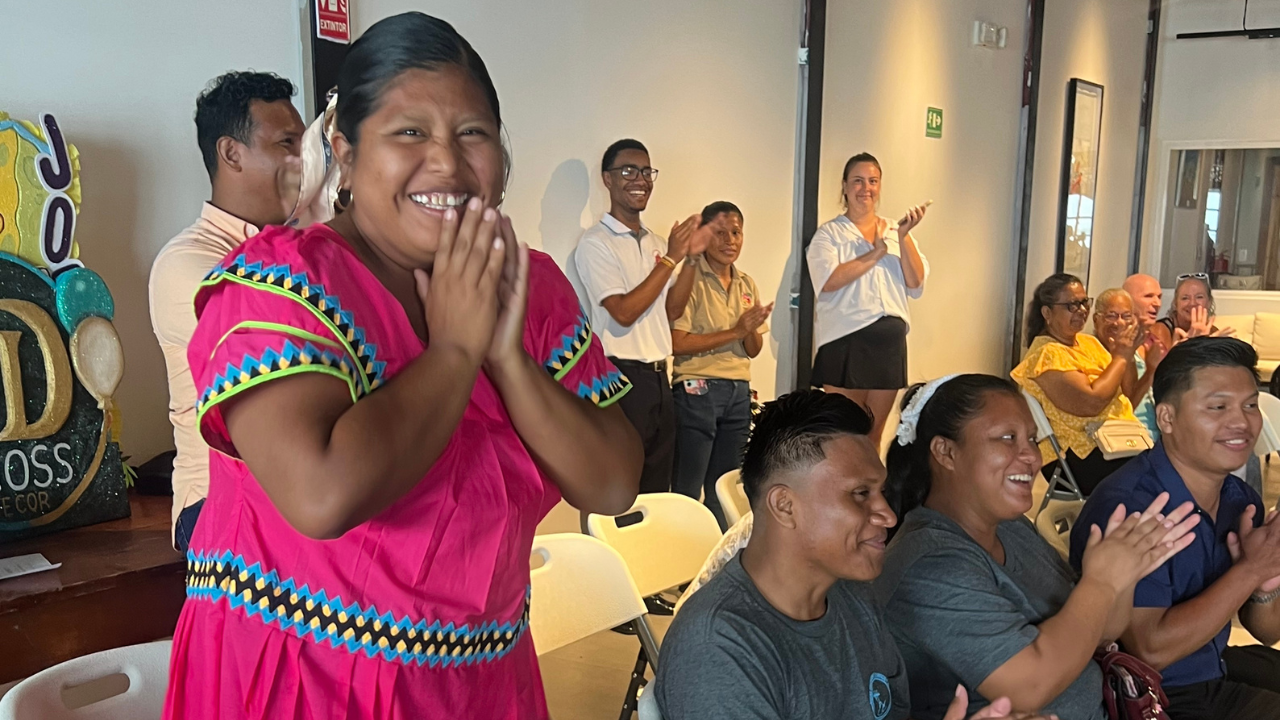
One young Panamanian woman felt the same way. Meet Kelly Hernandez, aka Miss Dirty Scrubs.

While Kelly was fortunate enough as a young girl to attend a good school that provided some health education, most of her female anatomy, reproductive health, and puberty education came from an encyclopedia that she found in her house. Menstruation was viewed as “bad luck” in her family and something “nobody should know about.” This is a shared sentiment in many communities and cultures in Panama and around the globe.
As an adult, Kelly decided to do something about this. She became a women’s health ambassador for Days for Girls and secured over 2,500 DFG Kits, which include a beautiful hand-stitched drawstring bag, washable and reusable pads, a carrying pouch for washing and storing, soap, panties, a washcloth, and an informative care and use sheet. To become an ambassador, Kelly completed a certification course through Days for Girls and follows their curriculum when she hosts women’s circles in the Ngäbe communities around Bocas del Toro.
In partnership with Floating Doctors and the Rotary Club of Bocas del Toro, Kelly has been able to distribute kits and provide education on periods, puberty, sex, violence, human trafficking, water, hygiene, reproductive health, and women’s rights. What’s more, is that these women’s circles also provide empowerment and mentorship opportunities.
Kelly estimates that well over 150,000 girls and women in Panama do not have access to this type of education, support, and feminine hygiene products. As all women know, pads and tampons are expensive, especially when you consider that you need them every month for decades of your life. In Bocas del Toro, a pack of disposable pads can cost anywhere between $1.50 and $4.00. Many women living on the Comarca and in other Ngäbe communities do not have an income. When Kelly distributed 44 kits to 44 girls and women on the Ngäbe-Buglé Comarca in Bisira, she calculated that this group would ultimately save between $3,168 and $6,336 that they don’t have over a two to four year period of time by using the reusable products she distributed to them.

Miss Dirty Scrubs has a full-time job, though, and hosting women’s circles in all the communities that need them is not a one-woman venture. She wants to grow this project, and since she already has over 2,000 kits available, the best way to support her is to become an ambassador for women’s health like her or donate to Floating Doctors to cover the costs of organizing more women’s circles. If you are interested in becoming an ambassador, Kelly can share the link to the certification course and provide all the additional information you need to get started so that you can host the circles and distribute the kits.
Imagine a world where all women felt empowered and were able to embrace and celebrate their womanhood—a world void of shame, stigma, taboo, and secrecy surrounding reproductive health. Imagine if every menstruating female could comfortably and safely take care of herself regardless of socio-economic status. These imaginations must become a reality, the norm, the non-negotiable status quo. Those of us who are period privileged women like me, must raise the bar for our sisters. Kelly has done a lot of heavy lifting and is a strong woman sharing her strength with those who need it, but we are strongest together.

Learn more and/or contact Kelly using the links below.
https://www.daysforgirls.org/our-mission/
keithlynhn@gmail.com (Kelly’s email)
Article by Jenn Parker. Check out more of her work on https://www.parkerjenn.com/






3 Responses
Thanks for writing such great article. I loved it
Is this something you are still a part of? I am moving to Panama in December 2022 and am looking for volunteer opportunities
Is this something you are still a part of? I am moving to Panama in December 2022 and am looking for volunteer opportunities